Discover the top 20 questions for your AI astrologer to get deep answers from birth chart insights to soul purpose, career timing, and relationship clarity.
You’ve probably felt this before. You’re staring at a birth chart maybe a client’s, maybe your own and everything is right there in front of you. The placements, the aspects, the patterns. You can feel the story trying to surface. You just can’t quite reach it.
So you open Astrologer Bot AI and type: “What does a Cancer Moon square Sun in Libra mean?”
The answer comes back accurate, well-organized, and somehow completely beside the point.
Not because the AI got it wrong. Because the question was too small.
Why This Matters More Than You Think
Here’s something most people figure out only after months of frustration: the gap between a flat response and a genuinely useful one has almost nothing to do with the technology.
It has everything to do with the question.
An AI astrologer isn’t a dictionary. It’s an interpretive partner one that can hold house rulers, aspect patterns, transits, and personal context together at the same time. But that only happens when you give it something real to work with.
The top 20 questions for your AI astrologer to get deep answers aren’t just prompts. They’re a different way of having the conversation entirely.
The responses are accurate. They’re also completely interchangeable, they could apply to anyone with that placement. And that’s the problem.
The real strength of Astrologer is interpretive synthesis: the ability to hold multiple chart factors in relationship simultaneously and surface meaning from the pattern they create together. But that only activates when you ask for it explicitly.
Think about what a skilled human astrologer actually does in a session. They don’t just read placements aloud. They probe. They look for the emotional through-line. They hold your chart as a story, not a spreadsheet.
When you build that same context into your prompts, you’re giving the AI the same material to work with.
The 3-Layer Question Framework
Before the questions themselves, here’s the most useful shift you can make right now.
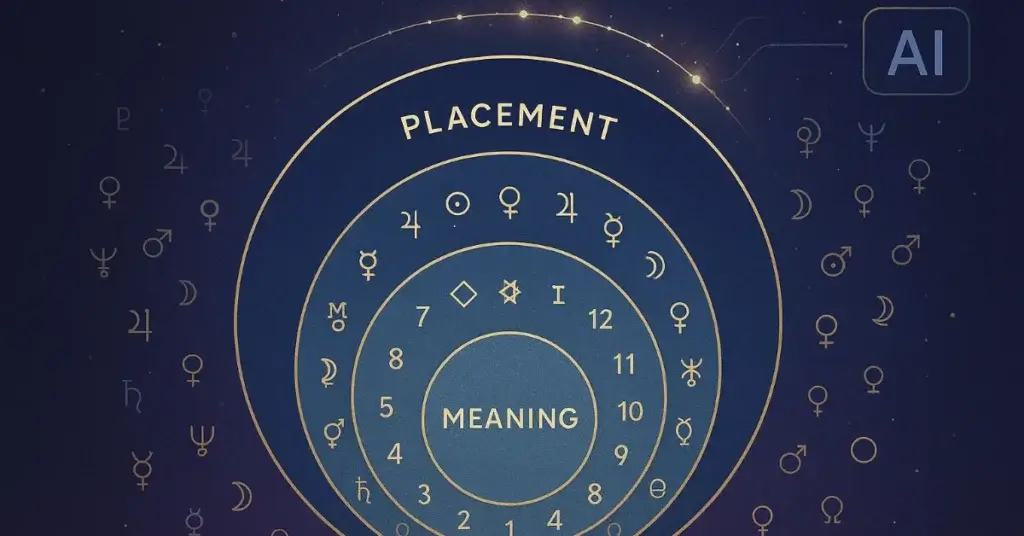
Every powerful AI astrology prompt has three layers:
Layer 1 – The Placement: What you’re asking about (a planet, house, aspect, or transit)
Layer 2 – The Relationship: How it connects to the rest of the chart
Layer 3 – The Meaning: What it suggests about your lived experience, patterns, or direction
A weak question hits Layer 1 only.
“What does my Mars in Aries mean?”
A strong question hits all three.
“How does my Mars in Aries interact with my Saturn opposition and what does that pattern suggest about where I tend to get in my own way?”
Same chart. Entirely different conversation.
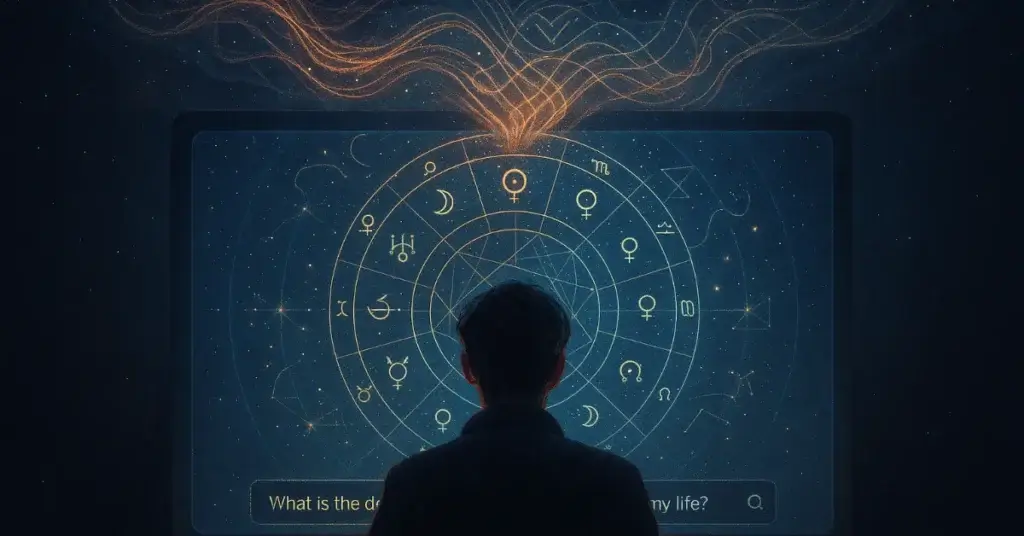
Illustration showing user exploring a digital birth chart with AI insights.
Top 20 Questions for Your AI Astrologer to Get Deep Answers
Birth Chart Foundations
1. “What is the most dominant pattern in my birth chart, and how does it shape my core personality?”
This invites synthesis rather than description. You’re asking the AI to identify stelliums, chart shapes, or angular emphases that define your overall energetic architecture not just comment on individual pieces in isolation.
2. “Which placements in my chart point to my greatest unresolved tension and what might resolve it?”
Squares and oppositions aren’t problems. They’re plot points. This question reframes difficulty as direction, and the answers here are often where the real work begins.
3. “If my chart had a central soul-level theme or lesson, what would it be?”
Slightly abstract, yes. But consistently powerful. This gives the AI permission to move past mechanics and speak in the language of meaning.
4. “What does my chart suggest about how I process emotion internally versus how others perceive me emotionally?”
A Moon-ASC-Venus question in disguise. The answers often illuminate relationship patterns people have been quietly confused by for years.
5. “Which house axis seems most activated in my chart, and what does that emphasis suggest about my life’s recurring themes?”
Ideal for anyone who feels persistently pulled between two contrasting areas of life, career versus home, independence versus partnership, visibility versus privacy.
Timing, Transits, and Cycles
6. “What are the most significant transits affecting me in the next 12 months and which one deserves the most attention right now?”
Asking for prioritization shifts the AI from listing dates to offering genuine interpretive guidance about where your energy actually belongs.
7. “How will the upcoming Saturn transit interact with my natal chart, and what should I be preparing for?”
Saturn transits are turning points. This question turns abstract astrological forecasting into something you can actually think about and act on.
8. “I’ve been in a period of stagnation. Based on my chart and current transits, when might I expect meaningful movement?”
You’ve probably felt this one personally at some point. It asks the AI to hold your lived experience alongside your chart and find real, specific timing patterns in the data not just general encouragement.
9. “What does my solar return chart for this year suggest about my dominant theme for the year ahead?”
Solar returns are one of the most underused techniques in contemporary astrology. Most people never think to ask.
10. “Are there any eclipses or outer planet ingresses in the next two years that will significantly affect my natal placements?”
Eclipse seasons and outer planet transits define entire chapters of a life. This question brings those macro-level forces into focus where they actually belong.
Career, Purpose, and Life Direction
11. “What does my Midheaven, its ruler, and any planets in my 10th house suggest about my most fulfilling career path?”
Not “what job should I get?” but an invitation for layered, nuanced vocational interpretation that actually goes somewhere.
12. “My North Node is in [sign/house]. What soul-level direction does this point toward and what patterns might be holding me back from moving toward it?”
North Node questions are among the most emotionally resonant you can ask. AI handles them with real sensitivity when prompted this specifically.
13. “Where in my chart do I show natural talent that I may be consistently underusing?”
Fifth house placements, Jupiter’s position, Venus by house the answers here are often quietly surprising in the best way.
14. “What does the relationship between my Sun, Moon, and Ascendant suggest about the gap between who I am, who I feel I am, and who the world sees?”
For anyone navigating questions of identity or the nagging sense that something doesn’t quite fit. Which, honestly, describes most of us at some point.
Relationships and Synastry
15. “In this synastry comparison, which connections suggest long-term compatibility versus short-term intensity?”
The difference between magnetic and sustainable is one of the most practically useful things astrology offers and this question draws it out directly.
16. “What does our composite chart suggest is the higher purpose or growth potential of this relationship?”
Asking about purpose rather than compatibility reframes the entire reading from the first sentence.
17. “Which aspects in this synastry chart might create recurring conflict patterns and what would help both people navigate them more consciously?”
This turns the AI from a prediction tool into something genuinely useful for the people involved.
Psychological Depth and Shadow Work
18. “If Pluto’s position and aspects in my chart represent my relationship with power, transformation, and shadow, what does it reveal about where I most resist change?”
Pluto questions, done well, are among the most honest conversations you can have with an AI astrologer.
19. “How do my 12th house placements shape my unconscious patterns and what might they be asking me to integrate?”
The 12th house is the most misunderstood area in all of astrology. A well-framed question opens it like almost nothing else can.
20. “Looking at my entire chart as a complete story what is the central arc, and where in that arc do I seem to currently be?”
This is the capstone question. It asks the AI to hold your chart as a living narrative rather than a set of data points. When it lands and it does the response can be genuinely surprising.
Visual three-layer framework of placement, relationship, and meaning.
Narrative arc question (“What story does my chart tell?”)
Synthesis-level meaning, soul themes
Big life transitions, annual reviews
Expecting literal prediction rather than pattern
Timing + lived experience (“I feel stuck, when might things shift?”)
Transit-based, specific foresight
Planning ahead, navigating uncertainty
Not including birth data alongside the question
Do This, Not That: The Most Common AI Astrology Mistakes
Don’t ask: “What does Mercury retrograde mean for me?”
Do ask: “How will Mercury retrograde in Virgo affect my natal Mercury in Gemini, and what communication patterns should I pay attention to during that period?”
Don’t ask: “Am I compatible with a Scorpio?”
Do ask: “My Venus is in Aquarius and their Moon is in Scorpio. Where does our synastry show the most potential friction and what would help us work with it rather than against each other?”
Don’t ask: “Is this a good year for my career?”
Do ask: “With Jupiter transiting my 10th house and Saturn approaching my natal Sun, what career themes are most likely to emerge this year and how might I position myself to work with them?”
The pattern is always the same. Move from what is this? to what does this mean for me, specifically, right now?
When One Question Changes the Whole Reading
Imagine this: you’ve been using an AI astrology tool for a few months. Your prompts are efficient. Organized, even. But something about the responses feels thin.
“Interpret this transit.” “Explain this opposition.” “What does this placement suggest about career?”
Accurate. Useful as a starting point. But not the kind of thing you’d want to bring into a client session or sit with for long.
Now imagine, before a particularly layered client session, you try something different. You input the full birth data and write: “If this person’s chart shows a central tension between the need for emotional safety and the drive for public recognition where does that show up most clearly, and what transits in the next 12 months might create either a crisis point or a resolution window?”
The response maps a Cancer Moon squaring a Libra Sun on the Midheaven, traces the theme through the 4th and 10th house axis, and identifies two specific transit windows one involving Saturn, one involving Jupiter that will activate that exact tension directly.
That’s not a smarter AI. That’s a smarter question.
The depth was always available. The question just needed to reach it.
Five Principles for Getting Consistent Depth
Getting genuinely useful responses from an AI astrologer doesn’t require anything complicated. It just requires one consistent habit: treat every prompt as a conversation opener, not a search query.
Always include birth data, date, exact time, and place of birth. Without this, even excellent questions produce generalized answers.
Name the area of life you’re currently navigating, career, relationships, identity, health. Context changes everything.
Ask “what does this suggest” rather than “what will happen” astrology is about patterns and probabilities, not fixed outcomes.
Follow up when an answer feels thin try “can you go deeper on that?” or “how does this connect to my 12th house?” AI astrologers respond well to layered dialogue.
Treat the AI as a collaborator the insight emerges in the exchange, not from a single output.
Research supports this more broadly. A 2023 study published in Computers in Human Behavior found that users who framed AI queries with specific context and layered intent received responses rated significantly higher in relevance and depth than those using broad or single-topic prompts.
The principle is universal and it applies directly to how you work with astrological AI.
The Right Questions Change Everything
“The cosmos is within us. We are made of star-stuff.” – Carl Sagan
Astrology has always been a practice of learning to ask better questions of the chart, of the sky, and ultimately of yourself. The top 20 questions for your AI astrologer to get deep answers aren’t scripts to follow. They’re a different way of holding the conversation.
When you bring specificity, context, and real curiosity to Astrologer Bot AI, something shifts. The responses stop feeling like definitions and start feeling like genuine insight. The chart stops being a locked room and starts being a map you can actually read.
Start with one question. Hold it honestly.
See where it takes you.
Try Astrologer Bot AI today and ask the question your chart has been waiting for.
Frequently Asked Questions
Q1: What makes a good question for an AI astrologer?
A good question has three layers: the placement or transit you're asking about, how it relates to the rest of your chart, and what it might mean for your actual lived experience. Specific and contextual questions consistently produce stronger responses than broad single-topic ones.
Q2: What are the best practices when using AI astrology tools regularly?
Keep a record of your most useful prompts. Revisit key transits seasonally. Follow up on responses that feel incomplete AI astrologers respond well to ongoing dialogue rather than isolated one-off queries.
Q3: How can AI astrology tools support professional astrologers?
For working astrologers, AI tools are most useful as interpretive partners during client preparation helping synthesize complex chart patterns, identify timing windows, and surface themes worth exploring in session. They work best when you bring the same depth of framing you'd bring to a live reading.
Q4: When is the right time to consult an AI astrologer?
Any major transition is a natural entry point: a career shift, a relationship change, a prolonged period of feeling stuck. Outer planet transits, eclipse seasons, and Saturn return periods are especially worth exploring with specific, well-framed questions.
Q5: What are the current trends shaping AI astrology tools?
The most significant shift is from keyword-based interpretation toward contextual synthesis tools that can hold multiple chart factors in relationship and generate narrative-level insight. Personalization, transit forecasting, and conversational follow-up capabilities are all developing rapidly across the category.
Q6: How do I know if an AI astrology reading is accurate?
Accuracy improves significantly when you provide exact birth data and ask specific, contextual questions. Treat responses as interpretive frameworks for reflection rather than fixed predictions the goal is pattern recognition, not certainty about future events.
Q7: Can AI astrology tools handle synastry and composite chart readings?
Yes, and they do so particularly well when you frame the question around purpose and growth rather than simple compatibility. Questions like "what does our composite chart suggest about the highest potential of this relationship?" consistently produce more useful responses than generic compatibility checks.
Q8: What is the top benefit of using an AI astrologer for personal self-inquiry?
Availability and depth without judgment. You can explore psychologically layered questions shadow work, unconscious patterns, soul-level tensions at any hour, without the vulnerability of saying those things out loud to another person. For many people, that's precisely where the real inquiry begins.