
Moon Phase Calculator
Discover which lunar phase you were born under with our free moon phase calculator, understand every moon phase in order, and learn how lunar cycles influence stargazing, gardening, and more.
Initializing Moon Calculator...
Here’s a question most people never think to ask: what moon phase was I born under? Yet the moment you find out, something clicks. Like discovering a missing piece of your personality puzzle. A moon phase calculator takes your birth date — your day, month, and year — and reveals the exact lunar phase that lit the sky when you took your first breath.
Whether you’re searching for your birthday moon phase, exploring moon phase compatibility, or simply curious about the lunar cycle, this tool hands you answers in seconds. I’ve spent decades studying how celestial patterns shape emotions, instincts, and even relationships. And honestly? Your birth moon phase carries a rhythm most people completely overlook. Use our free moon phase calculator to discover yours right now.
How to Read Your Birth Moon Story
Your birth moon phase isn’t just a fun fact. It’s a quiet imprint — a personal energy stamp that was present the moment you arrived.
Think of it like this. The sun tells the world who you are. Your moon sign reveals how you feel. But your moon phase when born? That tells you how you move through life.
Here’s how to read yours:
- Enter your birth date into the birth moon phase calculator — day, month, year, and local time if you know it.
- Find your phase — New Moon, Waxing Crescent, First Quarter, Waxing Gibbous, Full Moon, Waning Gibbous, Last Quarter, or Waning Crescent.
- Read the meaning — each phase carries distinct energetic qualities tied to beginnings, growth, release, or rest.
No coordinates needed. No manual calculations. The calculator does it all.
Expert tip: Pair your birth moon phase with your full birth chart for deeper insights. Your moon phase adds a layer that most readings miss entirely. It reveals whether you’re someone who initiates change or someone who reflects before acting.
What Does Your Moon Phase Mean?
Every moon phase holds a message. Here’s the short version:
- New Moon born — You’re a starter. Fresh beginnings live in your bones. You initiate without needing permission.
- Waxing Crescent born — Momentum is your thing. You push forward even when the path isn’t clear.
- First Quarter born — You thrive under pressure. Deadlines, problems, complications — you handle them.
- Waxing Gibbous born — You refine everything. Perfection isn’t a goal; it’s your nature.
- Full Moon born — Emotions run bright. You’re visible, magnetic, and fully illuminated in every room.
- Waning Gibbous born — You teach. Sharing knowledge and wisdom comes instinctively.
- Last Quarter born — You release what no longer works. Letting go isn’t hard for you — it’s necessary.
- Waning Crescent born — You rest with purpose. Surrender, reflection, and quiet knowing define you.
Ancient traditions guided planting cycles, ceremonies, and even rites of passage by these same phases. According to NASA’s lunar science page, the Moon completes one full cycle roughly every 29.5 days — a synodic month. That timing governed calendars for centuries before clocks even existed.
Your phase isn’t random. It’s a cosmic signature. To go even deeper, check your sun, moon, and rising signs together.
What Phase Is the Moon In Right Now?
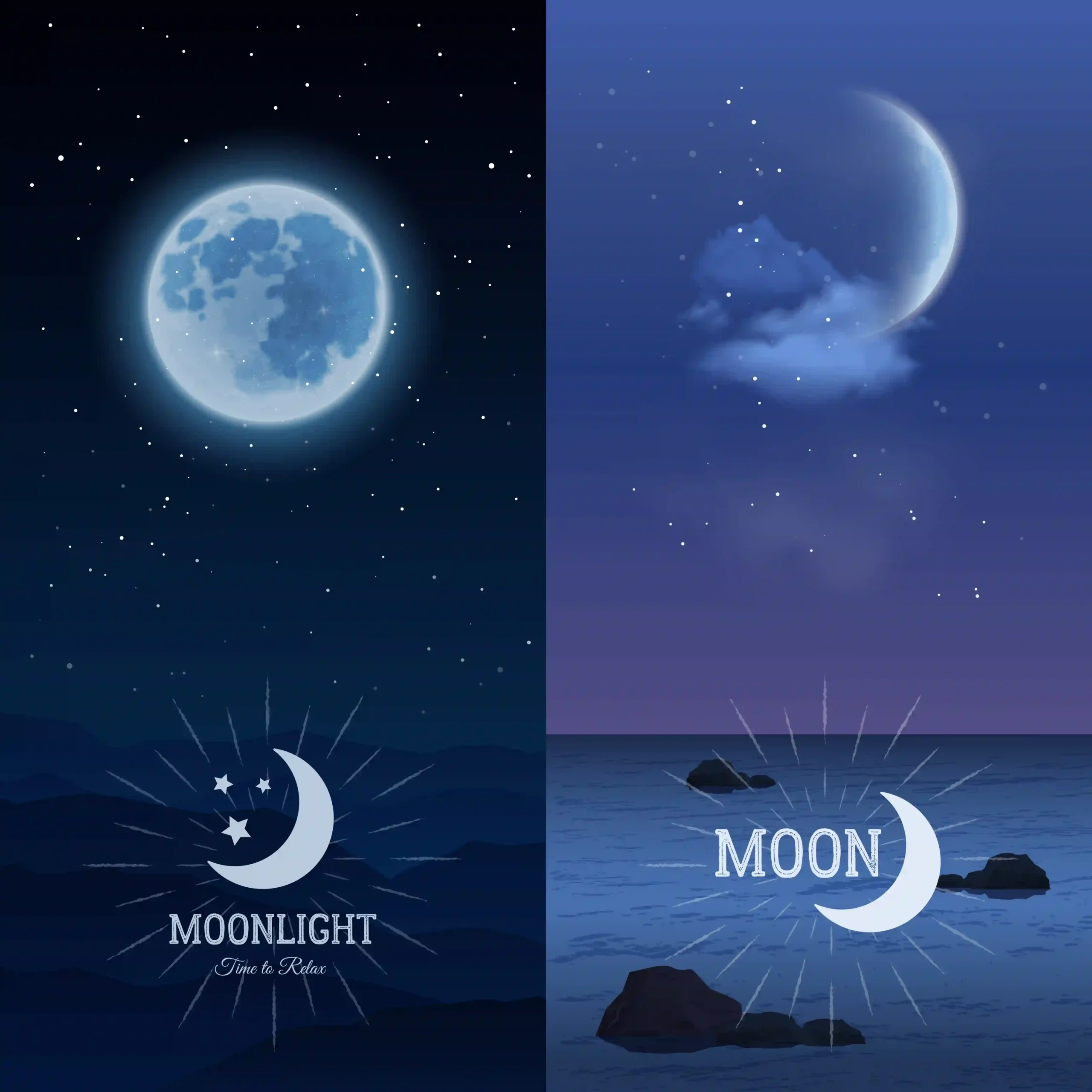
Right now, the Moon is somewhere in its 29.5-day journey. It might be a slim crescent, a bold half-disc, or fully illuminated.
The fastest way to check? Use our free lunar phases calculator above. It shows the current moon phase, tonight’s moonrise and moonset times, and the illumination percentage — all based on your location and timezone.
Knowing the current phase helps you plan everything from stargazing nights to personal rituals.
The 8 Moon Phases in Order (And What Each One Reveals)
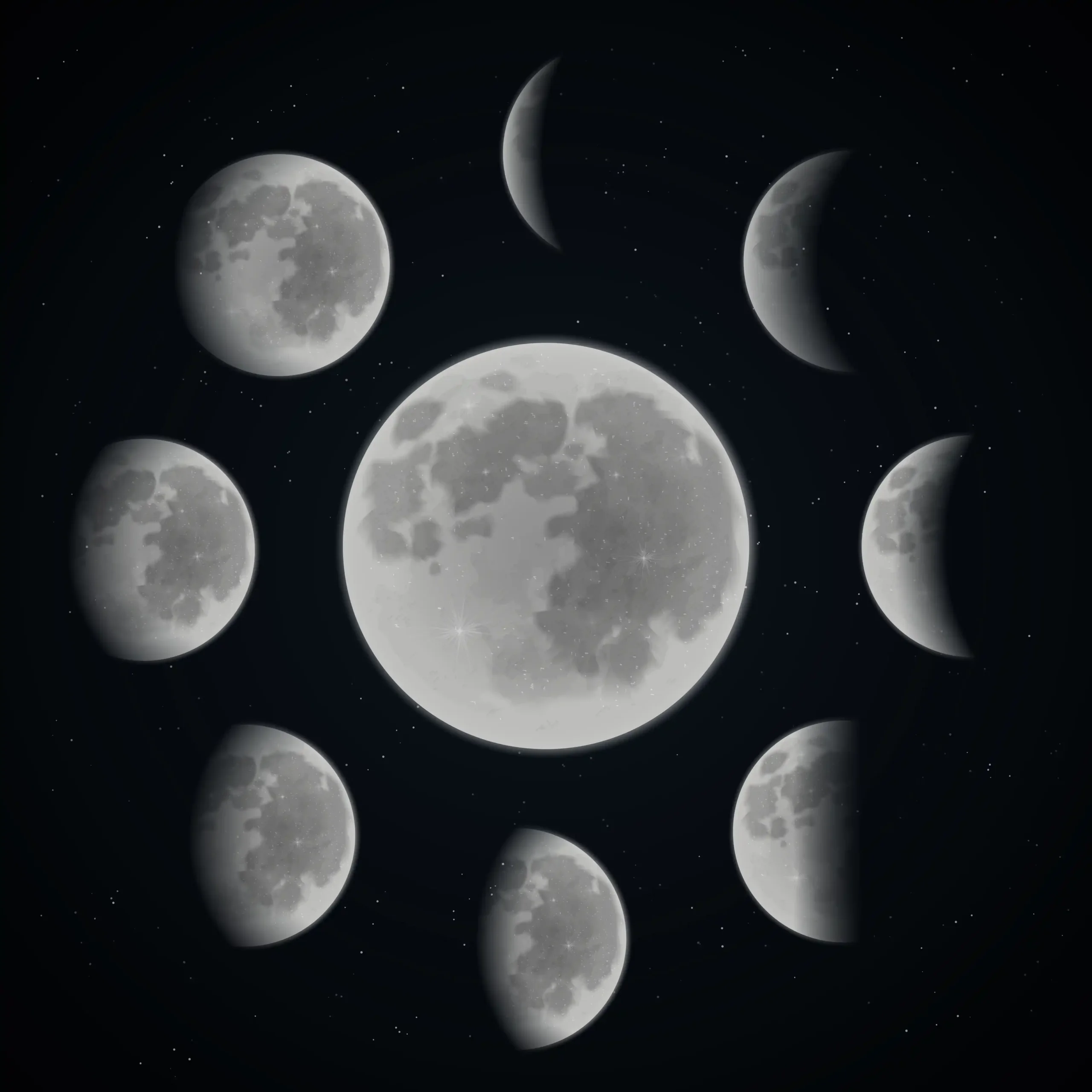
There are eight traditionally recognized moon phases — four major and four minor. They mark specific moments as the Moon’s appearance changes gradually across each cycle.
| Phase | Illumination | What It Reveals |
|---|---|---|
| 🌑 New Moon | 0% | The disc is invisible. A time for beginnings and setting intentions. |
| 🌒 Waxing Crescent | 1–49% (growing) | A thin sliver appears on the right side (northern hemisphere). Momentum builds. |
| 🌓 First Quarter | 50% (right half lit) | Half the disc is illuminated. Decisions and action dominate. |
| 🌔 Waxing Gibbous | 51–99% (growing) | Most of the disc shines. Refinement before completion. |
| 🌕 Full Moon | 100% | The entire face is illuminated. Emotions peak. Everything is visible. |
| 🌖 Waning Gibbous | 99–51% (shrinking) | Brightness starts to decrease. Sharing and gratitude surface. |
| 🌗 Last Quarter | 50% (left half lit) | The left half glows. Release and forgiveness become easier. |
| 🌘 Waning Crescent | 49–1% (shrinking) | A tiny sliver remains. Rest, surrender, and closure. |
Key point: In the southern hemisphere, the lit sides flip — left during waxing, right during waning. Near the equator, illumination appears at the bottom.
Each phase lasts approximately 3.7 days, and the full cycle spans around 29.5 days — one complete lunation.
How the Moon Rises, Moves, and Sets Each Night
The Moon doesn’t rise at the same time every night. That surprises most people.
Here’s the pattern:
- New Moon — Rises near sunrise, sets near sunset. It’s up during the day, invisible at night.
- First Quarter — Rises around noon, reaches its highest point at sunset, sets around midnight.
- Full Moon — Rises at sunset, stays visible all night, sets at sunrise. The brightest and most noticeable.
- Last Quarter — Rises around midnight, highest at sunrise, sets around noon.
The Moon rises in the east and sets in the west, just like the sun. But each night, it rises roughly 50 minutes later than the night before. That shift happens because the Moon orbits Earth while Earth rotates — so our planet needs a bit of extra rotation to “catch up.”
Understanding the Lunar Cycle: From New Moon to Full Moon and Back
The lunar cycle begins when the Moon aligns precisely between the Earth and Sun — that’s the New Moon. At this point, no sunlight reflects toward us. The disc appears dark.
Over the next ~14.7 days, the illuminated portion grows. This is the waxing phase. The Moon moves along its orbit, and the angle between Moon, Earth, and Sun increases until the Moon sits opposite the Sun — a Full Moon, roughly 180 degrees away.
Then it reverses. The lit area shrinks. This is the waning phase. The cycle completes when the Moon returns to its position between Earth and Sun.
One thing people get wrong: the Moon doesn’t emit its own light. It reflects sunlight. The phases we see are simply different angles of that reflected light as the Moon orbits us.
Fun fact from the Royal Observatory Greenwich: tidal locking means we always see the same side of the Moon. The far side? It receives sunlight too — it’s not permanently dark.
When and Where to See the Moon Tonight
Check your local moonrise time using the calculator. Then:
- Face south (northern hemisphere) or north (southern hemisphere)
- Look east after moonrise
- Track west as it sets
During a Waxing Crescent, look low in the western sky right after sunset. During a Waning Crescent, catch it in the eastern sky just before sunrise. The Full Moon? Simply step outside at sunset and look east. You can’t miss it.
The Perfect Time to Watch the Moon (And Why It Matters)
The best time depends on what you want to see:
- Surface details (craters, mountains, valleys) — Watch during the First or Last Quarter. The terminator line — where light meets shadow — creates dramatic contrast and a three-dimensional perspective.
- Brightness and atmosphere — The Full Moon rises at sunset and stays up all night. Convenient, bright, and stunning.
- Faint crescents — The thin Waxing or Waning Crescent phases are visible for short windows, but they’re uniquely beautiful against a darkened sky.
Pro tip: The atmosphere is clearest a few hours after moonrise, once the Moon climbs higher above the horizon. Low-angle viewing distorts details.
Which Moon Phase Unlocks the Best Stargazing Conditions?
Here’s the truth nobody tells beginners: the best stargazing happens when the Moon is gone.
A bright Full Moon washes out faint celestial objects — distant galaxies, nebulae, even dimmer stars vanish in the moonlight. So if you’re chasing deep-sky observations, plan around the New Moon when the sky is darkest.
But if you want to observe the Moon itself? The First Quarter offers the longest evening viewing hours, and the terminator line reveals stunning surface features even through a basic telescope.
Bottom line: Match your goal to the phase. Moon-watching? Quarter phases win. Star-hunting? New Moon darkness is your friend.
The Moon has quietly shaped human life for thousands of years — our calendars, our tides, our farming, even our feelings. And your moon phase calculator result? It’s a small but powerful piece of that story.
Whether you’re exploring moon phase compatibility with a partner, tracking tonight’s lunar cycle, or simply wondering what moon was I born under — now you have the answers. Discover yours with the Astrologer Bot and let your birth moon remind you of a rhythm that’s been yours since day one.
Frequently Asked Questions
How many Moon phases are there?
Why do we see different phases of the Moon?
How long does each Moon phase last?
How do I know if the Moon is waxing or waning?
When does the Moon rise tonight?
Do the phases of the Moon affect the tides?
How do the lunar cycles affect plants?
How do the lunar cycles affect hair growth?
What moon were you born under?
Free Astrology Tools
Unveil the cosmos with our professional astrological calculators. Discover ancient wisdom tailored to your soul's journey.
Synastry Chart Calculator
Analyze relationship dynamics deeply through detailed synastry chart comparisons and planetary aspects.
Calculate NowBirth Chart Calculator
Unveil the exact cosmic blueprint of your soul with a comprehensive, professional natal chart calculation.
Calculate NowLove Compatibility
Explore romantic compatibility between zodiac elements and discover your fated cosmic love connections.
Calculate NowSun, Moon & Rising
Discover your complete astrological trinity and understand how your core placements shape your personality.
Calculate NowLilith Sign Calculator
Uncover your Black Moon Lilith placement and explore the hidden, primal, and wild aspects of your psyche.
Calculate NowVenus Sign Calculator
Reveal how you love, value, and attract abundance based on your exact Venus placement at birth.
Calculate NowNorth Node Calculator
Find your North Node placement and unlock profound insights into your karmic destiny and life path.
Calculate NowPart of Fortune
Discover the exact point in your chart where worldly success, prosperity, and innate joy align naturally.
Calculate NowVertex Sign Calculator
Calculate your Vertex to reveal fated encounters, significant turning points, and karmic connections.
Calculate NowEnjoyed this article?
Save it & explore more on our Pinterest boards