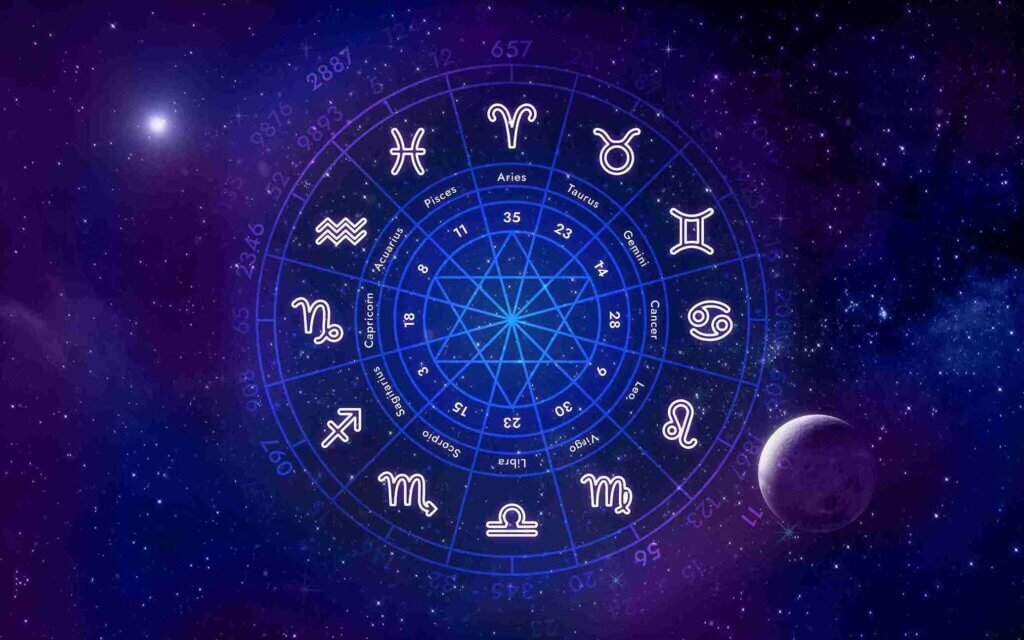
Picture this. You’re sitting with your birth chart open maybe it’s printed, maybe it’s on your screen staring at a wheel packed with glyphs, degrees, and crossing lines that you somehow know represent something real about you. You’ve read your sun sign a hundred times. You’ve Googled your moon sign. You’ve watched three videos about Saturn in Capricorn. You have pieces.
Best 5 AI Astrology Tools for Deep Chart Interpretation and What you don’t have is the story those pieces are telling together.
That gap between having a chart and actually understanding it is exactly where most AI astrology tools quietly fail. They give you a list. What you actually want is a reading. And there’s a real difference between the two.
The good news: a handful of tools are finally doing this properly. Not by craming in more placements, but by doing what a skilled astrologer does reading how every piece of the chart talks to every other piece, and translating that into something you can genuinely use.
Most AI astrology apps give you placements. The best ones give you the relationship between placements which is where real interpretation lives.
Deep birth chart analysis means treating the chart as a system. Every placement modifies every other. Tools that ignore this produce lists, not readings.
The right tool depends on how you think about charts not which app has the nicest interface.
No AI tool replaces a skilled practitioner’s intuition and presence. The best ones sharpen it.
What Most People Get Wrong About AI Astrology Tools
Here’s the misunderstanding worth clearing up before anything else: more placements listed does not mean deeper interpretation.
You’ve probably seen this pattern. An AI astrology app generates a long report sun sign, moon sign, rising, all twelve houses laid out in order. Each gets its paragraph. Each paragraph sounds plausible. But nothing connects. The Mars section doesn’t mention your Venus. The 7th house entry doesn’t acknowledge that its ruling planet sits in your 12th. The whole thing is technically thorough and intuitively empty.
Real astrological synthesis works completely differently. It reads the chart the way a skilled practitioner does as a conversation between its parts, where every placement modifies every other. Your Venus in Scorpio means something specific in the 2nd house. It means something quite different in the 8th. Your Saturn return lands differently depending on whether your natal Saturn has supportive aspects or sits under pressure from a Pluto square. The context is not decoration. The context is the interpretation.
The best AI astrology tools understand this distinction. The weakest ones dress up generic content in personalized packaging and call it a reading.
The global astrology market is projected to grow from $15.16 billion in 2025 to $27.15 billion by 2035 (Market Research Future) and a significant share of that growth is coming from people who are done with sun-sign content. They want the full chart. They want it to mean something specific to them, not to everyone born in the same month.
That demand is shaping something genuinely new in the AI astrology space. Here’s how to find the tools worth your time.
The 3-Level Framework: How to Evaluate Any AI Astrology Tool
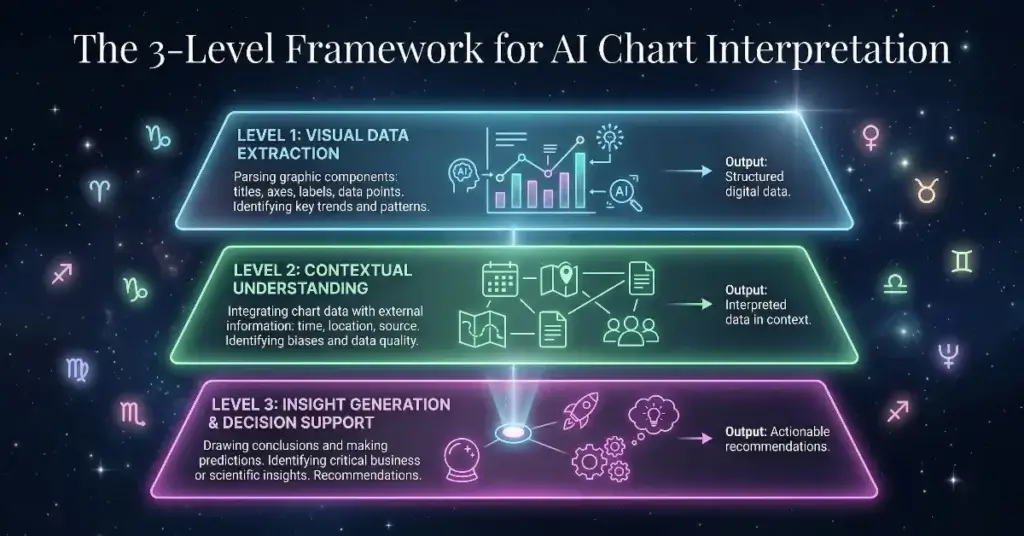
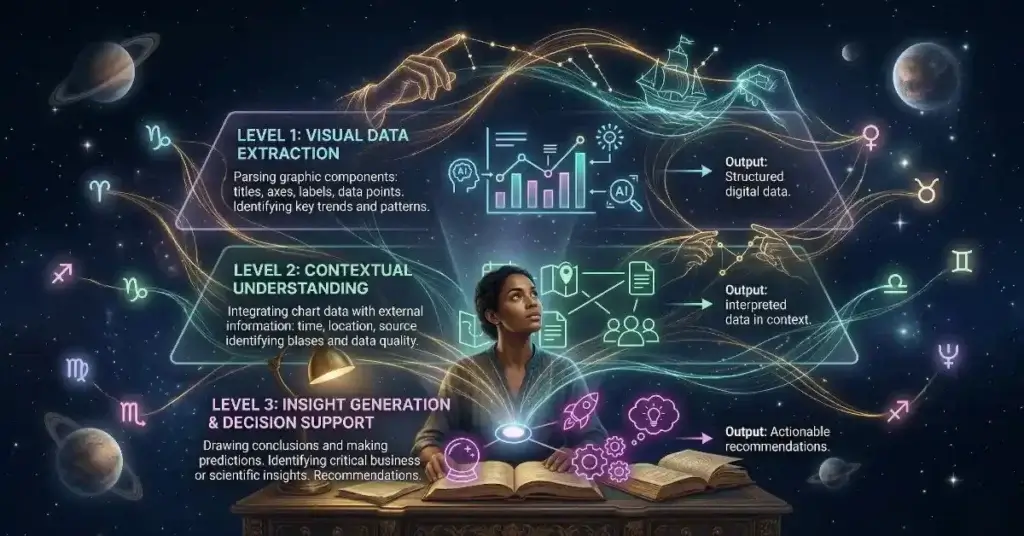
Before the list, here’s a framework you can apply to any AI astrology tool you come across. Think of chart interpretation as happening on three levels:
The 3-Level Framework for AI Chart Interpretation
Level 1 - Description: The tool tells you what’s in your chart. Your moon is in Scorpio. Mercury is in the 3rd house. This is calculation, not interpretation. Most apps live here and stop.
Level 2 -  Explanation: The tool tells you what individual placements tend to mean. A Scorpio moon brings emotional intensity. Mercury in the 3rd sharpens communication. Better -  but still isolated.
Level 3 -  Synthesis: The tool reads placements in relationship to each other — how they modify, intensify, or complicate one another. This is where real chart interpretation lives. And where very few AI tools consistently arrive.
When you’re evaluating any AI natal chart reading tool, ask yourself one clear question: which level does this actually operate on? The answer cuts through all the marketing.
The 5 Best AI Astrology Tools for Deep Birth Chart Interpretation
1. Astrologer Bot AI – Whole-Chart Thinking, Conversational Depth
Let’s start here, because this is the standard everything else gets measured against.
Astrologer Bot AI is built around a principle most apps quietly abandon in favour of simplicity: a birth chart has to be read as a system. Not a sequence. Not a collection of individual profiles. A system, where every placement informs every other placement simultaneously.
If you’ve ever sat with a skilled astrologer and felt that moment when they traced a thread between your 4th house ruler, a natal Venus-Saturn square, and a current Pluto transit and it suddenly explained something about your relationship with home that you’d never quite been able to articulate that’s the experience a Level 3 tool is trying to produce. That’s what Astrologer Bot AI is reaching for.
2. Co-Star – The Entry Point That Earned Its Reputation
It would be easy to dismiss Co-Star because it’s popular. That would be a mistake.
Co-Star’s natural-language engine uses NASA data, coupled with the methods of professional astrologers, to generate insights about who you are and how you relate to others. (Co-Star) Real human astrologers collaborate with AI technology to produce both the birth chart and the daily horoscopes the app delivers. The result is polished, visually clear, and at its best genuinely insightful about the relational dynamics between two people’s charts.
3. Selfgazer – Where Jungian Psychology Meets Planetary Interpretation
There are tools that read your chart. And then there are tools that ask why you want to know.
Selfgazer takes a Jungian psychology framework as its foundation – approaching birth chart analysis less as a personality profile and more as a map of the psyche. (Selfgazer) It doesn’t just tell you your 12th house is active. It helps you sit with what that might reveal about patterns you haven’t fully seen in yourself – the unlived life, the inherited tendencies, the unconscious material that Pluto keeps bringing up at inconvenient moments.
On the technical side, Selfgazer’s calculations are powered by Swiss Ephemeris, the same professional-grade astronomical engine used by expert astrologers worldwide. You’re not sacrificing accuracy for depth. You’re getting both.
4. AstroChart.ai – The Multi-Tradition Navigator
Most Western astrologers work inside one system their whole career. AstroChart.ai is quietly built for the ones who’ve started to wonder what they’re missing.
The platform covers Western tropical astrology, Vedic astrology including 27 Nakshatras and Dasha timing cycles, Chinese Four Pillars of Destiny, Human Design, Astrocartography, and Numerology – all unified in one place. (AstroChart.ai) If you’ve ever wondered how a client’s Vedic chart interacts with what you’re seeing in their Western placements, or whether their Human Design type sheds light on the vocational questions their 10th house is raising, this is the tool that lets you ask those questions without switching between five different apps.
At a Glance: Choosing the Right Tool for Your Practice
Not every tool on this list is built for the same reader – and that’s a feature, not a flaw. Use this to orient yourself quickly.
Interpretation requires the practitioner’s own synthesis
What This Actually Looks Like in Practice
Here’s a pattern worth recognising, because you may have lived some version of it.
Imagine an astrologer mid-career, a decade of study behind her, a growing client base, genuine skill. She’s started taking on more bookings than she probably should, and the preparation work before each session is quietly eating into the rest of her week. She needs a way to think through complex chart configurations faster. Not to have the reading done for her. Just to not start from zero every time.
She tries several AI astrology apps. Most give her Level 1 or Level 2 output placement descriptions assembled into a report format. Useful for a client who’s never seen a chart before. Not useful for her.
Then she finds a tool that can hold a question like: “How does this Venus-Pluto opposition interact with a natal 7th house ruled by Mars in Aries, where Mars is also conjunct the South Node?” and answer it in relational terms, not isolated ones. Session preparation that used to take 45 minutes drops to 20. Her notes become tighter. Her clients start remarking, unprompted, that readings feel more cohesive.
Her skill didn’t change. Her starting point did. That’s what the right tool actually does.
How to Choose: A Simple Decision Checklist
Ask yourself which of these sounds most like you right now. Start there.
You want whole-chart, conversational synthesis and the ability to ask follow-up questions → Astrologer Bot AI.
You’re new to birth chart analysis and want a clear, low-friction starting point → Co-Star.
Psychology and inner work are central to your practice → Selfgazer.
You work across traditions, advise on relocation, or want Vedic and Western readings together → AstroChart.ai.
You need the most technically precise free calculation tools available → Astro-Seek.
Frequently Asked Questions(FAQs)
What makes a good AI astrology tool for birth chart interpretation?
A genuinely good tool reads your chart as an integrated system, not a sequence of isolated placements. It should explain how your planets, houses, and aspects interact with one another, support follow-up questions, and calculate from verified astronomical data Swiss Ephemeris and NASA-sourced ephemeris are the standards worth looking for.
How does Astrologer Bot AI approach chart interpretation differently from other tools?
Astrologer Bot AI is built around whole-chart synthesis meaning it reads how placements interact, not just what they mean individually. The conversational format lets you ask follow-up questions about specific transits, aspect patterns, or timing cycles, which is where the real interpretive value lives for practicing astrologers.
What are the best practices for getting an accurate AI birth chart reading?
Always enter your exact birth time, date, and place of birth even a 15-minute error can shift house cusps significantly. Start broad, then narrow: get the full chart picture first, then ask targeted questions about specific areas of life or timing. Treat the first output as the starting point, not the whole conversation.
What trends are shaping AI astrology tools right now?
The clearest trend is the move from static reports to conversational, memory-enabled tools that track your chart across multiple sessions. Multi-tradition platforms combining Western, Vedic, and Chinese systems are expanding fast. And there’s growing demand for tools that connect astrological interpretation to psychological frameworks, particularly Jungian approaches.
When should a practicing astrologer start using an AI chart interpretation tool?
When client preparation time is consistently cutting into your availability. When you want a second perspective on complex aspect configurations before a session. Or when you’re studying and want to test your own interpretations against a broader body of astrological knowledge. The tool should work for you not replace the work you already do well.